
Suspenders After Surgery or With an Ostomy
If a belt has become something you cannot wear, you already know why you are here. After abdominal surgery, with a hernia, or with an ostomy pouch, the last thing you want is a strap cinched across your belt line all day. You still need your pants to stay up.
The short answer: suspenders move the job of holding up your pants from your waist to your shoulders, so the waistband can sit as loose as you need and nothing squeezes your midsection. HIKERS® Co. suspenders are the reengineered kind: made in your size with no bulky buckles, flat nylon hooks that attach to your pants' own button and belt loops, and designed to disappear under an untucked shirt. Customers recovering from colon surgery, living with a hernia, and wearing an ostomy pouch have told us this is exactly why they bought a pair.
Why a belt is the wrong tool right now
A belt works by compression. It squeezes your waist until friction holds the pants, and it has to stay tight to keep working. That is a poor arrangement at the best of times; over an incision, a hernia, or a stoma and its wafer it is not an option. Loosening the belt does not help either, because a loose belt stops holding anything.
Suspenders do not compress. A few ounces of gentle tension from your shoulders hold the waistband wherever you set it, over the site or under it. Your waist is not involved. You can size up a waist so the pouch has room to fill, sit, bend, and eat without adjusting anything, and nothing presses on the stoma, the wafer or the pouch.
The same goes for men with Crohn's disease, ulcerative colitis or diverticulosis, where a cinched waistband is a daily irritant rather than a surgical site. Customers with each of those have written to us over the years, and the reason is always the same: take the constriction off the waist.
What touches you, and what does not
With HIKERS® Co. suspenders, the only contact points on your pants are the ones your pants already have: the front button and the belt loops. There are no clamps on the waistband fabric and no sizing hardware against your chest.
- HIKERS® Button Fly Suspenders attach at two points: the front waist button and one center rear belt loop. One soft strap runs over each shoulder and down the center of your back. The front attaches at the fly button, at the waistband line, so nothing sits above it on your abdomen. This is the lighter, simpler option, for pants and shorts with a front button.
- Upfitter® Belt Loop Suspenders attach at three points: two front belt loops and one center rear loop. They work with any closure (button, zipper, snap, slide), can be worn under or over your shirt, and are our best-seller. If your site is near the front center of your waistband, the two front hooks sit out at the loops, to either side of it.
Both are made from silky-soft elastic and sit flat under a t-shirt or button-down. Most men forget they have them on after the first day.
Suspenders and your ostomy wrap or hernia belt do different jobs
An ostomy wrap, a Stealth Belt, a hernia belt or a stoma guard supports or protects the pouch. None of them is built to hold your pants up, and asking a wrap to do a belt's job means tightening it. Suspenders hold the pants. Wear both: the wrap takes care of the pouch, the suspenders take the waistband's job to your shoulders, and the belt loops stay empty. One of our customers wears HIKERS® Button Fly Suspenders under his shirt with a hernia belt every day, and told the ostomy community about it before he told us.
Nobody sees them
The usual knock on suspenders for ostomates is that they show unless you wear a jacket. These do not. HIKERS® Co. suspenders were designed from the start to disappear under an untucked shirt: soft flat straps, no sizing buckles because every pair is made in your size, and flat nylon hooks at the waistband. Jeans and an untucked t-shirt look exactly the way they did before.
Choosing between the two
Pick by where your site is and what your pants have.
| HIKERS® Button Fly Suspenders | Upfitter® Belt Loop Suspenders | |
|---|---|---|
| Attaches to | Front button + center rear loop | Two front loops + center rear loop |
| Front contact | At the fly button, center | At the two front belt loops, either side |
| Pants that work | Any with a front button and a rear loop | Any with belt loops, any closure |
| Worn | Under an untucked shirt | Under or over the shirt |
| Sizes | XS to 4X | XS to 4X (Heavy Duty to 5X) |
Customers with an ostomy have mostly chosen HIKERS® Button Fly Suspenders: one attachment at the fly button and nothing out at the sides of the waistband, where a pouch often sits, and they wear jeans and an untucked shirt the way they always did. If your pants have no front button, or you want to wear suspenders over your shirt, Upfitter® Belt Loop Suspenders are the pair. If you would like a second opinion on your pants, email us a photo of the waistband and we will tell you what works.
If you have looked at side-clip undergarment suspenders, here is the difference. Side clips clamp onto the waistband fabric at your hips, which is often exactly where a pouch sits, and clips let go when you bend. HIKERS® Co. hooks lock onto the belt loops your pants already have, at the fly button and the center rear (Button Fly) or at the front loops and the center rear (Upfitter®), so nothing clamps the waistband next to a wafer and nothing pops off when you sit down.
Getting them on and off, without reaching or twisting
Putting them on takes about as long as a belt. Slip the straps over your shoulders, hook the front first (your pants are now held up), then reach around and hook the rear loop. For the bathroom, standing, most men do not unhook anything. Seated, you can unhook only the rear hook so the straps slide forward with you, or, with Upfitter® Belt Loop Suspenders, release the two front hooks and leave the rear attached, so there is no reaching behind your back at all. Nothing comes off over your head and your shirt stays on.
If someone is helping you dress, the hooks tilt on and off with one hand.
Sizing, and if the first size is not right
Sizes run like t-shirt sizes, and we ask you to measure once: from the top of your center rear belt loop, over your shoulder, down to your front button. Match that number to the size chart. Between sizes, order the larger one. Every pair arrives set to its stated size with two notches on the rear strap to tighten as your weight or your pants change, and each notch is one size.
If the first pair does not fit, size exchanges are free within 30 days, refunds within 60, and manufacturer defects are covered for 100 days. Return shipping is free.
A word on the medical side
We make suspenders, not medical equipment, and nothing here is medical advice. Your surgeon, your WOC (wound, ostomy and continence) nurse, or your physical therapist is the right person to ask about waistband height, what should sit over your site, and when to start wearing anything that pulls at your pants. Bring them this page if it helps. What we can tell you is what our customers tell us: they wanted their pants up and their midsection left alone, and this did that.
Suspenders after surgery and with an ostomy: FAQs
Can you wear suspenders after abdominal surgery?
Yes, and many men do precisely because a belt is out. Suspenders hold your pants from the shoulders with gentle tension, so the waistband can sit loose and nothing presses on the incision. HIKERS® Co. suspenders attach only at your pants' button and belt loops, with flat nylon hooks and no buckles. Ask your surgeon when it is fine to start, and about waistband height.
Are suspenders good for people with an ostomy bag?
They can help with the one problem a belt creates: pressure. HIKERS® Co. suspenders take the waistband's job to your shoulders, so you can wear pants loose over or under the pouch and nothing cinches your middle. The only contact points are the pants' own button and belt loops. Your ostomy nurse is the person to ask about pouch position relative to the waistband; the suspenders simply hold the pants where you put them.
What is a comfortable alternative to a belt after a hernia?
Suspenders. A belt compresses the very area you are protecting; suspenders do not touch it. Upfitter® Belt Loop Suspenders from HIKERS® Co. hook onto your pants' belt loops, are made in your size with no bulky hardware, and disappear under an untucked shirt. A hernia belt or binder is a medical device your doctor prescribes for support; suspenders are not that, and the two do different jobs.
Will the suspenders press on my stoma or my incision?
No. HIKERS® Co. suspenders do not touch your abdomen; they attach to your pants' front button (HIKERS® Button Fly Suspenders) or front belt loops (Upfitter® Belt Loop Suspenders) at the waistband, and to one rear belt loop. The straps run over your shoulders and down your back. Where the waistband itself sits relative to your site is up to you and your care team.
Can I put them on and take them off without twisting?
Yes. Hook the front first, then the rear. Seated, unhook just the rear hook, or with Upfitter® Belt Loop Suspenders release the two front hooks and leave the rear attached, so nothing requires reaching behind your back. Nothing goes over your head and your shirt stays on.
Can I wear suspenders with an ostomy wrap, a Stealth Belt or a hernia belt?
Yes, and that is the combination most of our ostomy customers use. The wrap or hernia belt supports the pouch; HIKERS® Co. suspenders hold your pants up from your shoulders, so the wrap never has to be tightened to do a belt's job and the belt loops stay empty. Nothing from the suspenders touches the wrap or the wafer.
Do they work with elastic-waist or drawstring pants?
No. Every HIKERS® Co. style needs belt loops, and HIKERS® Button Fly Suspenders also need a front button. If recovery has you in elastic-waist pants without loops for now, keep this page for when you are back in regular pants, or choose pants with loops and an elastic waist, which many brands make.
Every pair comes with our 100% Iron-Clad Guarantee, free U.S. shipping over $20, and free size exchanges. Try the pair that fits your pants: HIKERS® Button Fly Suspenders or Upfitter® Belt Loop Suspenders.
Which HIKERS® Co. Suspenders Style is Right for You?
-
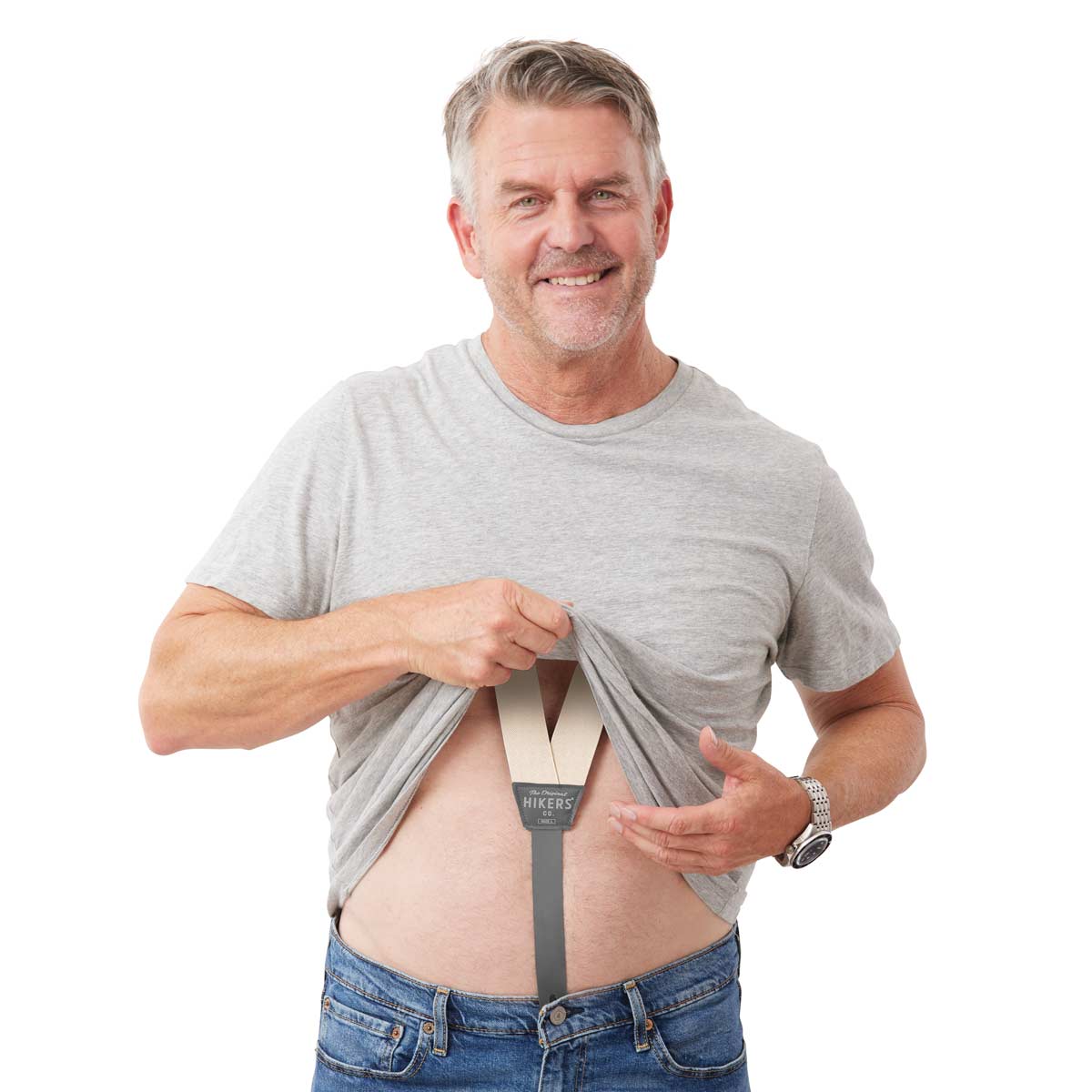
2-Point Button Fly Suspenders
Try HIKERS® Button Fly SuspendersIf you wear your shirts untucked and most of your pants have a button closure, our original 2-point button fly suspenders might be right for you. They attach to your button fly and rear belt loop, and theyʻre so comfy youʻll probably forget you have them on.
-
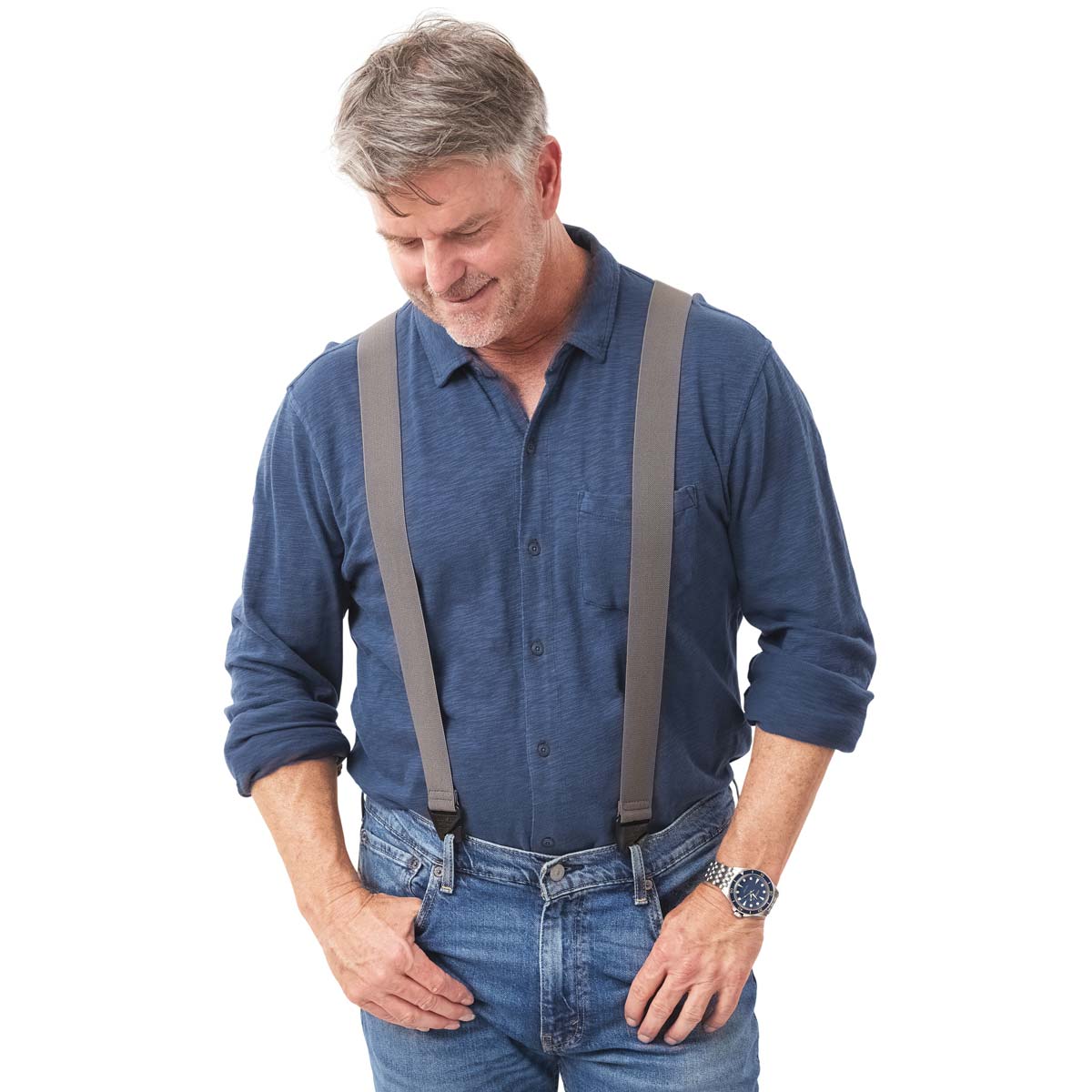
3-Point Belt Loop Suspenders
Try Upfitter® Belt Loop SuspendersWhen you need to tuck-in your shirts, our 3-point belt loop style is comfortable enough to wear hidden under an untucked shirt, or you can wear them on the outside like traditional suspenders. Plus, if you wear pants with slide or snap closures, these are for you.
-
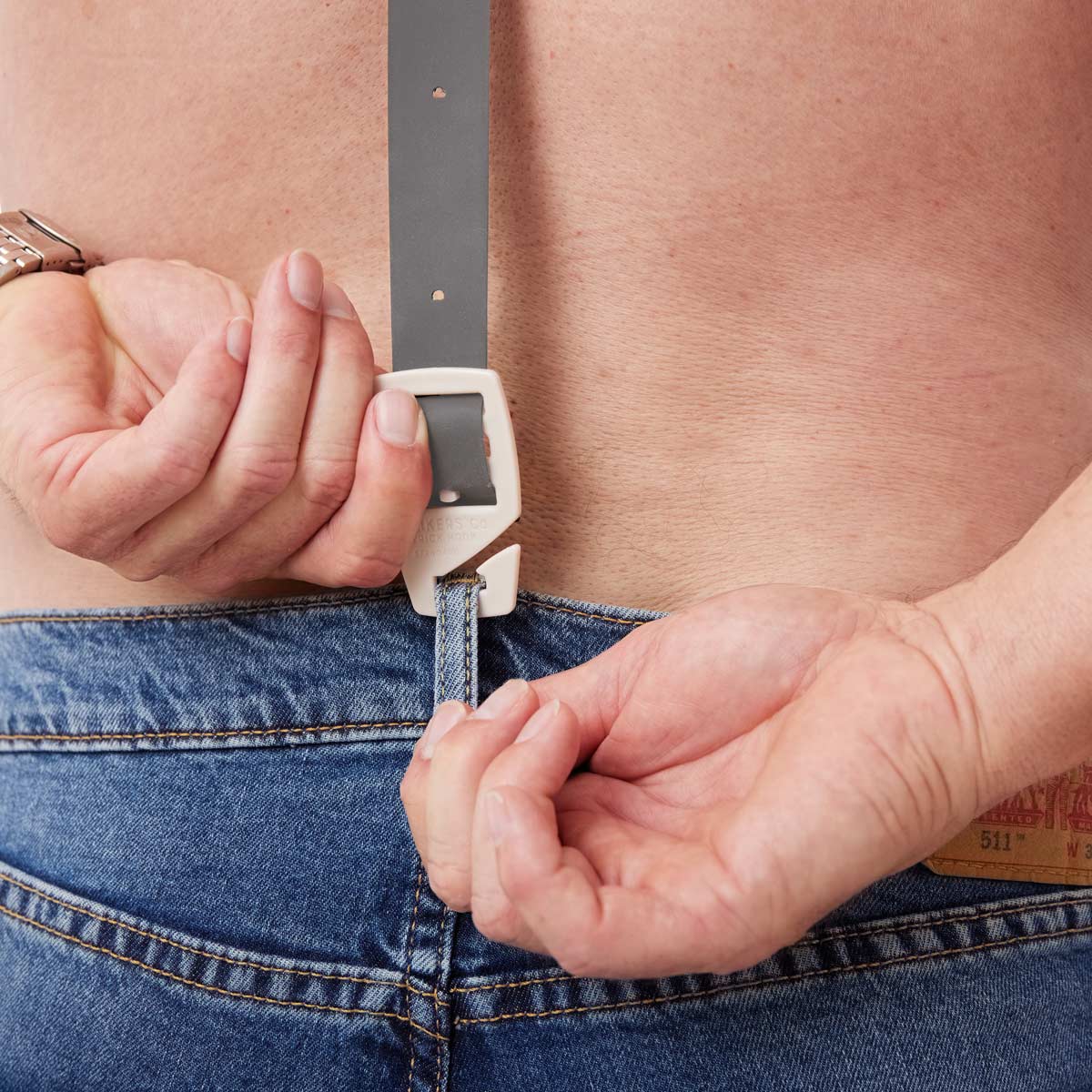
Made in your Size - Adjust to Fit
Find your SizeAll styles are made to fit in your size and can be adjusted to fit by rethreading the rear hook. Every pair has 3 sizes on the strap. If you order a Large, for instance, the strap is adjusted to size Large when they arrive, but it may be tightened down to Medium or Small as well.
FAQ
Common Questions
Are they comfortable?
Absolutely! How often do you loosen your belt or unbutton your pants? Are you eager to get home at night and change into something more comfortable? When you’re wearing HIKERS® Co. suspenders, your pants can be a little looser because tightness is no longer a factor in keeping them from slipping down. See for yourself: just read a few of our verified Customer Reviews and then try a pair for yourself.
Will they give me a wedgie?
Nope, wedgies don't happen when you order them in your size. It takes much less force to pull pants up than to cinch them on. Wedgies don’t happen with HIKERS® Co. suspenders for two reasons: 1. Your stomach stops them from inching up, and 2. all HIKERS® Co. suspenders come in your size and are adjustable, so the upward tug is Goldilocks perfect.
Do I have to disrobe to go to the bathroom?
Heading to the john could not be easier. HIKERS® Co. suspenders stay in place under your shirt so there’s no need to disrobe. Simply unhook and go about your business. About as quick as a belt and much faster than traditional suspenders.
Standing to pee with HIKERS® Co. suspenders is easy. Most guys don't unfasten them. Just unbutton your pants and let HIKERS® hold up your pants while you do your business. When you need to sit, you can leave your shirt on and try a couple of different options:
Unfasten the rear hook only. Your suspenders will slide forward as you sit down. When you stand up, reach up your back to pull the hook down and refasten. If the hook climbs up your back a little bit while you're sitting and becomes hard to reach, you can try a couple of things to slide it back down to where you can grab it. You can push up on the triangular patch in the front of your HIKERS®, or you can grab the straps near your shoulders to slide them back into position so you can easily reach your hook.
Wonʻt they tear my belt loops?
Nope, it doesn't happen. Considering the construction of Upfitter® Suspenders, the stretch of the straps, and the fact that the weight is distributed evenly around your body, it's not a likely issue. Given the average weight of your pants (even loaded with your phone, keys, and wallet), there's less than a pound of force on your rear belt loop (and there's two sewn seams keeping that loop on tight).
More importantly, we tested these for a full year before launching and have now sold over 100,000 pairs. We can confidently say that belt loops aren't failing with HIKERS® Co. Suspenders.
Why not just wear a belt?
If you're asking this question, you probably don't know how hard it is for some of us to keep our pants up. Whether it's noassatall syndrome or a belly pushing down your belt, for some of us belts simply don't work. And don't even get us started on how unhealthy it is to cinch your belt like a tourniquet around your vital organs all day long!
Got More Questions?
Contact Us anytime via email or check out our FAQ & Comfort Guide where we answer our most frequently asked questions.